What Is A GTM Agency? What It Should Actually Build
A practical definition of what a GTM agency should actually build: buyer clarity, offer, channels, sales follow-up, RevOps, and systems the client keeps.

A GTM agency helps a company build the path from target buyer to revenue.
That sounds simple. It is not.
Most companies do not have a "we need more marketing" problem. They have a buyer-to-revenue problem hiding behind marketing language. The offer is unclear. The ICP is too wide. Sales is guessing. CRM is messy. Ads, outbound, LinkedIn, SEO, and referrals all exist in separate little worlds.
Then someone says, "We need a GTM agency."
Sometimes they are right. Sometimes they just need one competent operator to tell them the uncomfortable thing: the channel is not the problem yet.
What Does GTM Actually Mean?
GTM stands for go-to-market. Salesforce defines a go-to-market strategy as a step-by-step plan for introducing a product to buyers, covering market, customer, channel, pricing, competition, and the revenue path.
That definition is useful, but in 2026 it is too narrow if you read it only as "product launch plan."
The phrase go-to-market came from older ideas in distribution, channel strategy, product marketing, and sales execution. There does not seem to be one verified person who "coined" it. The cleaner way to say it is this: the term became more formal in business writing around the late 1990s and early 2000s as companies started treating channels, market entry, sales motion, and customer access as one strategic problem.
Lawrence G. Friedman published Go-to-Market Strategy: Advanced Techniques and Tools for Selling More Products, to More Customers, More Profitably in 2002. Harvard Business School wrote about V. Kasturi Rangan's Transforming Your Go-to-Market Strategy in 2006, arguing that many companies built channels from the supplier outward instead of from the customer inward.
That point still matters.
Most bad GTM is built from the company outward.
"We have a product. Now how do we sell it?"
Better GTM starts from the buyer inward.
"Who has this problem, why would they care now, and what path would make buying feel obvious?"
So, What Is A GTM Agency?
A GTM agency designs and operates the system that connects your offer to revenue.
Not just traffic. Not just meetings. Not just a clean strategy deck that dies in Google Drive.
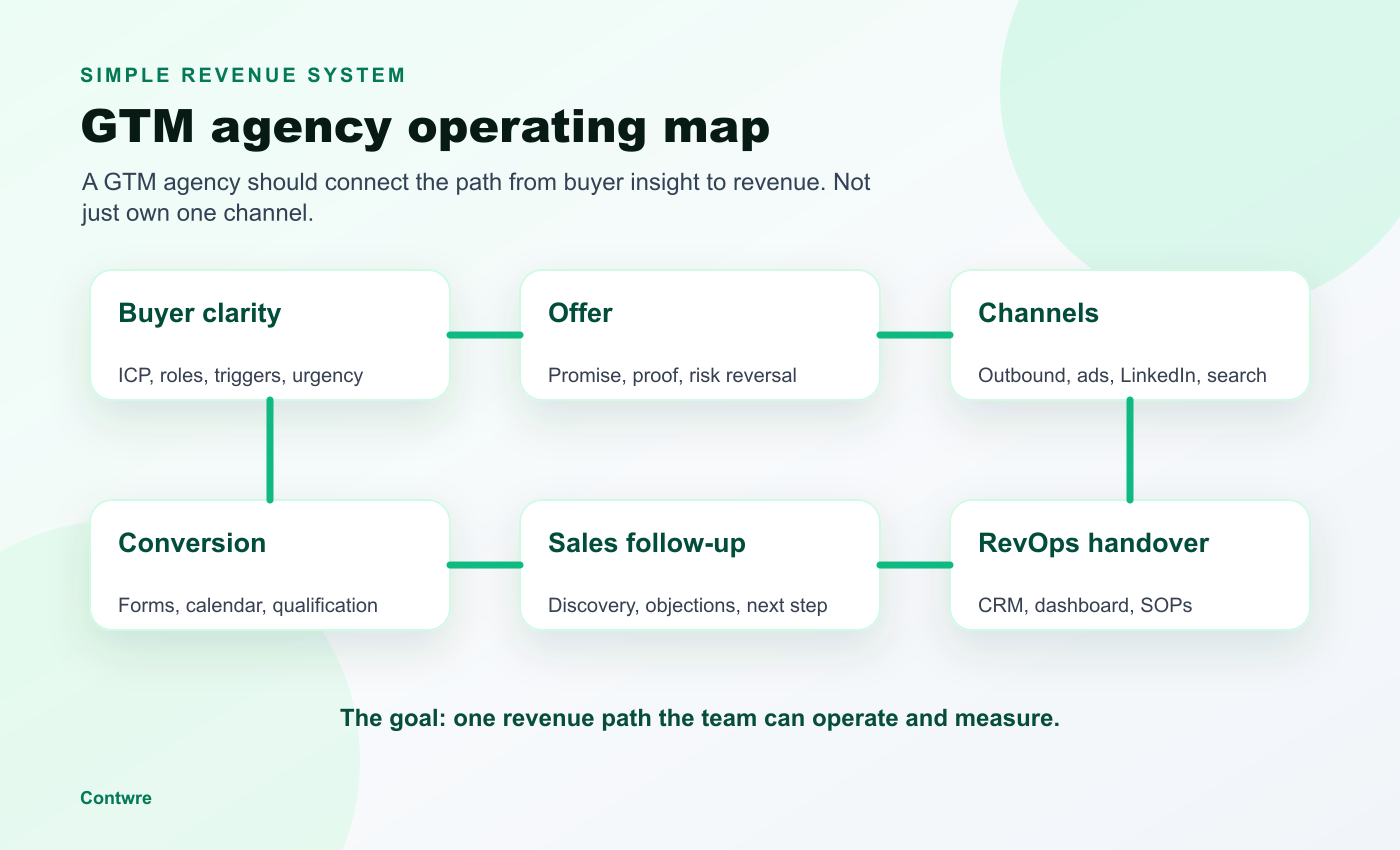
A serious GTM agency looks at the full chain: market, ICP, positioning, offer, channels, conversion path, sales follow-up, CRM routing, reporting, and handover. If one part breaks, the rest gets more expensive.
That is why GTM is different from normal marketing.
Marketing might get attention. Outbound might get replies. Paid ads might get leads. RevOps might clean the CRM. Sales training might improve calls.
GTM asks whether all of those pieces are creating the same revenue motion.
Market: Where can we realistically win? Segment map, category context, competitor understanding
ICP: Who feels the pain now? Account criteria, buyer roles, triggers, exclusions
Offer: Why would they act? Promise, proof, risk reversal, timeline, CTA
Channel: Where should we reach them? Outbound, LinkedIn, paid, partners, search, events
Conversion: What happens after interest? Landing path, qualification, calendar, follow-up
Sales: How does the conversation move? Discovery flow, objection notes, proposal process
RevOps: How does the system stay visible? CRM routing, dashboards, attribution, lifecycle stages
Enablement: What does the client keep? SOPs, playbooks, training, handover docs
This is where many agencies quietly fail.
They own the part they sell. They do not own the path.
Why GTM Agencies Became More Important
The buyer changed.
BCG wrote about a "Go-to-Market Revolution" back in 2014, arguing that customer pathways, technology, analytics, and globalization were changing how companies needed to deploy commercial capabilities. That was before the current AI-search mess, before every founder had access to automated outbound, and before buyers got trained to ignore most sales messages by default.
Now the problem is sharper.
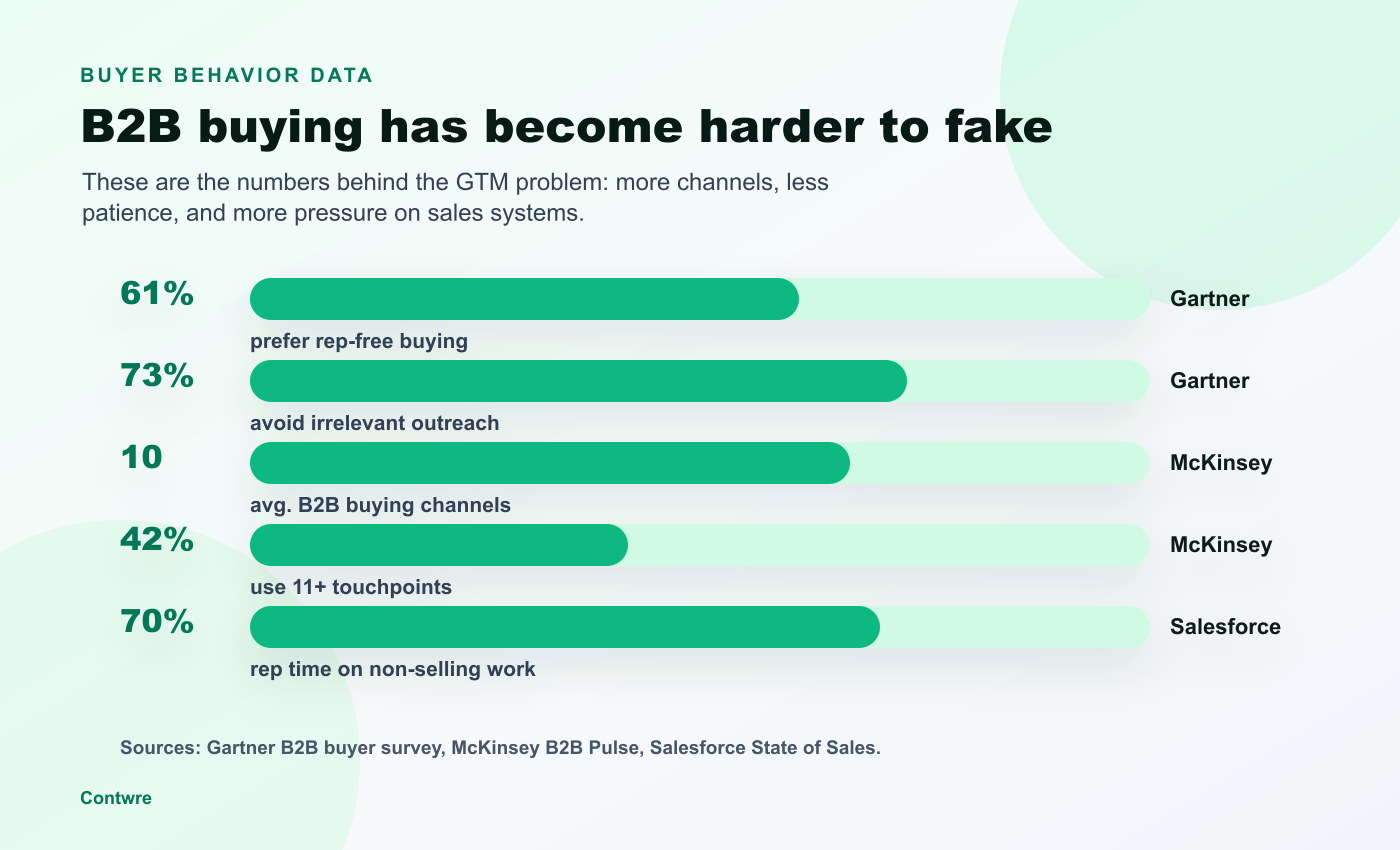
Gartner reported in 2025 that 61% of B2B buyers prefer an overall rep-free buying experience. The same Gartner survey found that 73% actively avoid suppliers who send irrelevant outreach.
That does not mean sales is dead.
It means lazy selling is expensive.
Buyers still talk to sellers when the decision is complex, risky, or politically sensitive inside the company. They just do not want a salesperson to repeat basic information they already found through Google, ChatGPT, review sites, competitor pages, LinkedIn posts, and private communities.
McKinsey's B2B Pulse research shows the same shift from another angle. B2B buyers use an average of ten interaction channels across the buying journey, up from five in 2016. McKinsey also found that 42% of respondents used more than 11 touchpoints, and more than half said they may switch suppliers if the experience across channels is not smooth.
Read that again.
The problem is not whether you should use cold email, ads, LinkedIn, SEO, partner marketing, or founder-led content.
The problem is whether the buyer can move across those channels without the system sounding confused.
If the ad says one thing, the landing page says another, the sales call starts from zero, the follow-up is generic, and the CRM cannot tell where the opportunity came from, you do not have a channel problem.
You have a GTM problem.
The Disruptive Part: GTM Is Not A Function
This is the part most articles avoid.
GTM is not a department. It is not a campaign type. It is not a prettier name for marketing.
GTM is a pressure test of whether the business knows how revenue is supposed to happen.
That is why a good GTM agency may tell you not to run ads yet. It may tell you not to scale outbound yet. It may tell you to stop buying tools. It may tell you the sales team is not the bottleneck. It may tell you the offer is too vague and no amount of "personalization" will rescue it.
That is annoying advice.
It is also usually where the money is.
Salesforce's 2024 State of Sales research found that 67% of sales reps did not expect to meet quota, 84% missed quota the previous year, and reps reported spending 70% of their time on non-selling tasks. Salesforce also reported that 59% of B2B buyers say reps do not take the time to understand their business' unique challenges and objectives.
So when a company says, "We need more leads," the real question is:
Can your current system even handle better leads?
More pipeline can make a broken system worse. It creates more admin, more no-shows, more bad qualification, more founder frustration, and more fake certainty in reports nobody trusts.
How Many GTM Agencies Are There?
There is no credible global census of GTM agencies.
That answer is less satisfying than a big fake number, but it is more honest.
The category is still messy. Some firms call themselves GTM agencies. Some call themselves revenue consultancies, growth agencies, product marketing firms, RevOps partners, demand generation agencies, outbound agencies, or sales-led growth consultants. Directories also split them across marketing, sales consulting, business consulting, lead generation, and CRM categories.
The result: you can find many agencies doing GTM work, but you cannot cleanly count "all GTM agencies in the world" without defining the category yourself.
That is exactly why the keyword is interesting.
The demand is real, but the category is not fully settled. People are searching for "GTM agency" because they feel the pain, not because the market has agreed on a perfect definition.
For Contwre, that is a good category to compete in. The confusion creates room for a clearer point of view.
GTM Agency vs Marketing Agency
A marketing agency usually sells execution inside a channel.
A GTM agency should diagnose the revenue path before choosing the channel.
Ironpaper, for example, describes go-to-market agency work as including marketing efforts, content, messaging, channel execution, sales resources, analytics, buyer intelligence, and continuous improvement. GTMVerse positions GTM as ownership across market clarity, pipeline, and future strategy rather than isolated execution.
Those are useful signals because they show how the category is moving. GTM agencies are not just selling one channel. They are selling ownership of the commercial motion.
Here is the clean distinction:
A marketing agency asks, "How do we get more attention?"
A lead generation agency asks, "How do we get more meetings?"
A RevOps agency asks, "How do we clean and measure the system?"
A GTM agency asks, "What should happen between buyer pain and revenue, and where is that path breaking?"
That question changes the work.
It means the agency has to understand the buyer, offer, sales motion, channel logic, data flow, and execution capacity. Otherwise it is just a vendor with a better label.
What A GTM Agency Should Build In The First 30 Days
The first month should not be chaos disguised as momentum.
It should be diagnosis, quick wins, and system design.
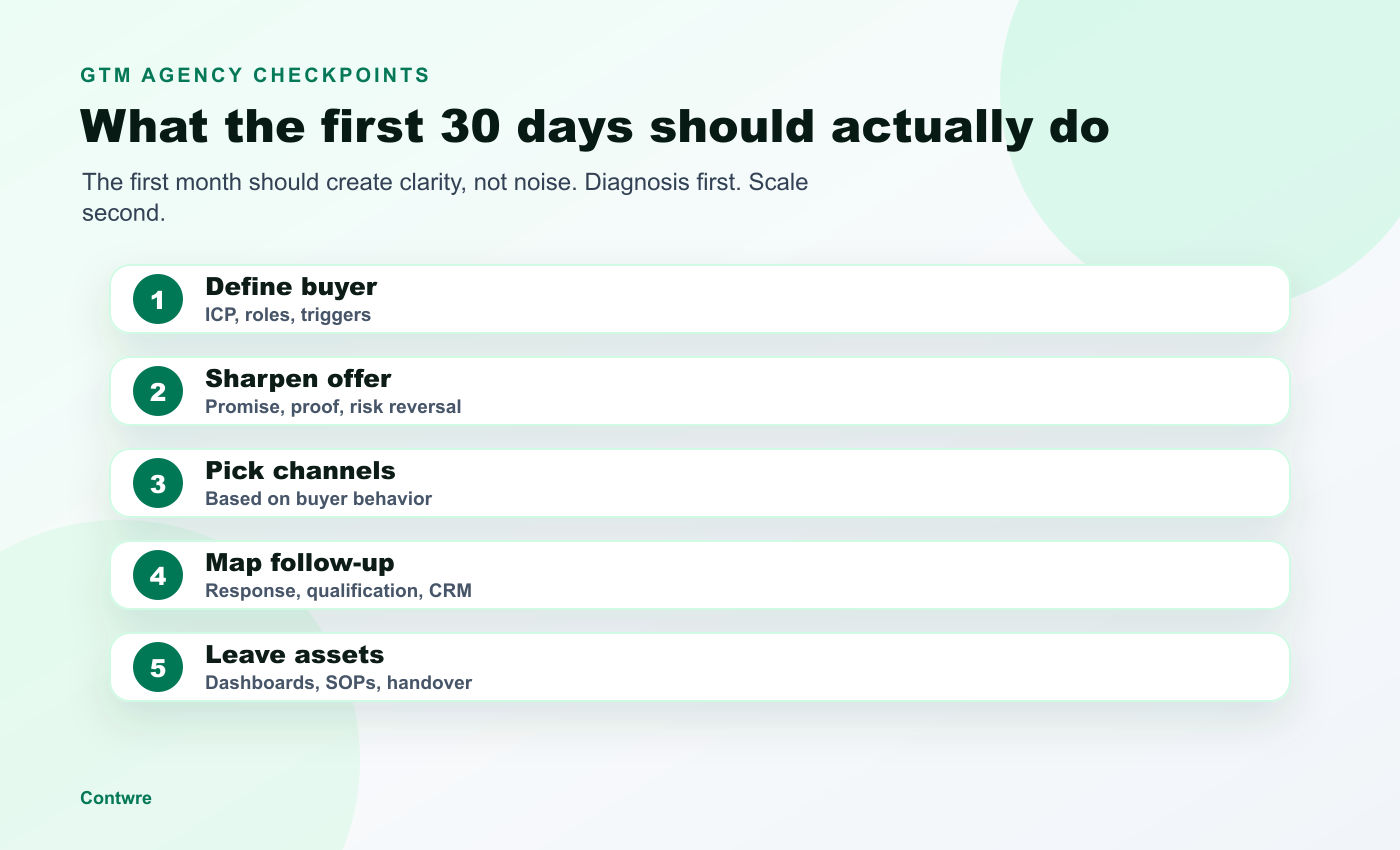
First, the agency should define the real buyer. "SaaS companies" is not an ICP. "B2B SaaS companies in the US, 11-100 employees, founder-led sales motion, ACV above $5,000, currently relying on referrals or founder outbound, with no clean CRM attribution" is closer.
The point is not to describe a market. The point is to find the accounts most likely to feel the problem deeply enough to move.
Second, the agency should inspect the offer. This is where many teams want to skip the uncomfortable work. They want better copy, better subject lines, better creatives, better automation. Sometimes they need those things. Often they need a clearer promise, stronger proof, a better risk reversal, and a more obvious reason to act now.
If your offer is weak, the channel will not save it.
Third, the agency should choose channels based on buyer logic. Cold outbound works when the buyer is identifiable and the problem is specific. Paid acquisition works when the angle is strong and qualification is tight. LinkedIn works when trust and expertise matter. Search works when demand already exists and the category has enough intent.
There is no morally superior channel.
There is only buyer behavior.
Fourth, the agency should map what happens after interest. Who responds? How fast? What does sales know before the call? What disqualifies a lead? What happens after a no-show? What is the follow-up logic? Where is the source tracked? What does the founder actually see every week?
This is the boring part.
It is also where campaigns become revenue.
Fifth, the agency should leave the client with assets. CRM fields. Dashboards. Outreach infrastructure. Sequences. Qualification rules. Sales notes. SOPs. Handover docs. Reporting cadence.
The best outcome is not needing the agency forever.
Where Contwre Fits
Contwre is a GTM agency for founder-led SaaS, B2B tech, specialized services, and selected e-commerce companies that need the revenue system built, not just discussed.
Our work can include cold outbound, LinkedIn pipeline systems, paid acquisition, CRM routing, RevOps, sales enablement, dashboards, and handover.
But the channel comes after diagnosis.
We are not a fit if you only want a cheap lead dump. We are not a fit if the offer is not validated and you want execution to hide that. We are not a fit if the team wants more activity but refuses to fix what happens after a lead arrives.
We are a fit when the business has something real to sell and needs a revenue system that can be built, operated, measured, and eventually owned by the team.
If that sounds like the actual problem, start with the AI strategist. It will help you pressure-test where the system is breaking. If you already know the problem is bigger than one campaign, use contact.
When You Should Hire A GTM Agency
Hire a GTM agency when the problem crosses functions.
If paid ads generate leads but sales says they are bad, you need GTM diagnosis. If outbound gets replies but meetings do not convert, you need GTM diagnosis. If founders still own every serious deal and the CRM cannot explain source quality, you need GTM diagnosis.
You probably do not need a GTM agency if the problem is only ad creative, only CRM cleanup, or only sales coaching. Hire the specialist for that.
You also should not hire a GTM agency if nobody has ever paid for the offer, the founder cannot explain the buyer's pain, or the product cannot fulfill what sales promises.
GTM cannot rescue a business that is avoiding the actual problem.
Sometimes the answer is not more pipeline.
Sometimes the answer is:
Fix the offer. Talk to the buyer. Read the sales calls. Sit with the data long enough for it to annoy you.
FAQ
What is a GTM agency?
A GTM agency helps a company design and operate the path from target buyer to revenue. That usually includes ICP, offer, positioning, channel strategy, outbound or paid acquisition, CRM routing, sales enablement, and reporting.
How is a GTM agency different from a marketing agency?
A marketing agency usually owns channels such as ads, content, SEO, or social. A GTM agency connects channels to the broader revenue system: buyer definition, offer, sales process, CRM, qualification, follow-up, and handover.
When should a startup hire a GTM agency?
A startup should consider a GTM agency when it has a validated offer but cannot turn interest into repeatable pipeline. If the offer is still unproven, the first job is diagnosis, not scaling campaigns.
What should a GTM agency build?
A serious GTM agency should build a clear ICP, offer and messaging, channel plan, outbound or paid acquisition system, CRM routing, reporting dashboard, sales follow-up process, and operating cadence.
What is a bad sign when hiring a GTM agency?
A bad sign is when the agency starts with its preferred channel before diagnosing your buyer, offer, deal size, sales motion, and follow-up process.
Source Notes
The history section uses Lawrence G. Friedman's 2002 book listing on Google Books, Harvard Business School's 2006 article on V. Kasturi Rangan's Transforming Your Go-to-Market Strategy, and BCG's 2014 article on the Go-to-Market Revolution.
The buyer behavior section uses Gartner's 2025 B2B buyer survey, McKinsey's 2024 B2B Pulse research, Salesforce's go-to-market strategy guide, and Salesforce's 2024 State of Sales research.